If you own a commercial building in Middlesex County and you’re staring down a 1031 exchange deadline, take a breath first. You have more time — and more paths — than the clock makes it feel like.
Here’s the situation a lot of New Jersey commercial owners find themselves in this time of year: you sold (or are about to sell) an investment property, and now you’re inside a 1031 exchange — a federal tax rule that lets you sell one investment or business property and roll the proceeds into another one without paying federal capital gains tax right away, as long as you follow the IRS’s timeline. That timeline is unforgiving: 45 days from your closing to identify a replacement property, and 180 days total to close on it. Miss either window and the tax deferral goes away. For an owner along the Route 1 or Route 130 corridor trying to line up a small industrial building, a retail pad, or a mixed-use property in that window, a traditional listing — with showings, financing contingencies, and a buyer who might fall through in week five — can feel like it’s working against the calendar instead of with it.
What are your actual options?
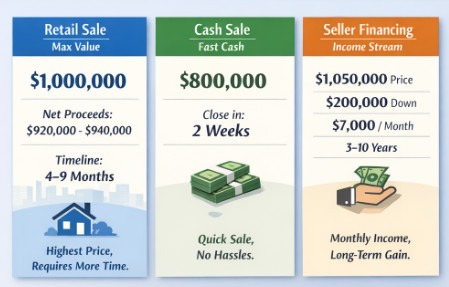
- List with a commercial broker. Still the right call if your target property isn’t time-sensitive, or if you’re not the one on the identification clock. A good local broker knows the Middlesex County market and can move quickly when needed.
- Sell on the open market yourself. Possible if you already have a buyer relationship or the property is turnkey. It just tends to take longer to get to a firm, financed closing.
- Take a direct cash purchase or off-market solution. A private buyer who can underwrite the property in days, not weeks, and close on a date that fits your 45- or 180-day window — without a financing contingency sitting between you and the finish line.
None of these is automatically “right.” A well-priced, well-located building might sell just as fast through a broker. The point of a direct sale isn’t to skip the process — it’s to remove the parts of the process most likely to blow up your timeline.
Where a direct sale actually helps
An off-market sale tends to make the most sense when:
- You’re inside your 45-day identification window and need a buyer who won’t need a mortgage contingency to close.
- The building has tenants in place and you don’t want a parade of showings disrupting them mid-lease.
- The property needs work you’d rather not fund before selling — deferred maintenance, code items, or an aging roof or HVAC system.
- You just want one conversation and a clear number, not a listing process layered on top of an already tight exchange calendar.
It’s not the right fit for every seller. If you have time, a stabilized asset, and a broker relationship that’s worked before, listing traditionally may net you more. You’re not the first Middlesex County owner to weigh this trade-off under a deadline — and you won’t be the last.
A local note
New Jersey adds its own wrinkle: if you’re a nonresident seller using a 1031 exchange, your settlement agent needs Form GIT/REP-3 (the state form that documents your exemption from New Jersey’s estimated exit tax withholding) filed at closing, or the state will withhold funds at the closing table regardless of your federal exchange. This is exactly the kind of detail a qualified intermediary and a real estate attorney should walk through with you — we’re not tax or legal advisors, and nothing here should be read as either. If you don’t already have a qualified intermediary lined up, that’s the first call to make, before the property search.
Patriot Property Buyer purchases commercial buildings directly across Middlesex County and the rest of New Jersey — occupied or vacant, as-is, on a closing timeline built around your exchange deadline rather than a buyer’s mortgage approval. We’re one option among several, and we’ll tell you plainly if a traditional sale is likely to serve you better.
Own a commercial property you’re ready to move? Start a discreet, off-market conversation.
Patriot Property Buyer is not a law firm, lender, or tax advisory. Nothing in this article is legal, financial, or tax advice — talk to a licensed attorney, CPA, or qualified intermediary about your specific 1031 exchange and New Jersey exit tax situation. Cash offer amounts and timelines are determined case-by-case and confirmed in writing.